Sponsored by


In today’s post:
🚀 BofA Has A Crush On SpaceX
😬 $63B AI Loan Nearly Died
🤝 What The U.S. Offered Putin

Buffett says knowledge builds like compound interest. Get the key ideas from The Intelligent Investor, Business Adventures, and more in 15 minutes with Shortform. Start learning!
🚀 BofA Has A Crush On SpaceX
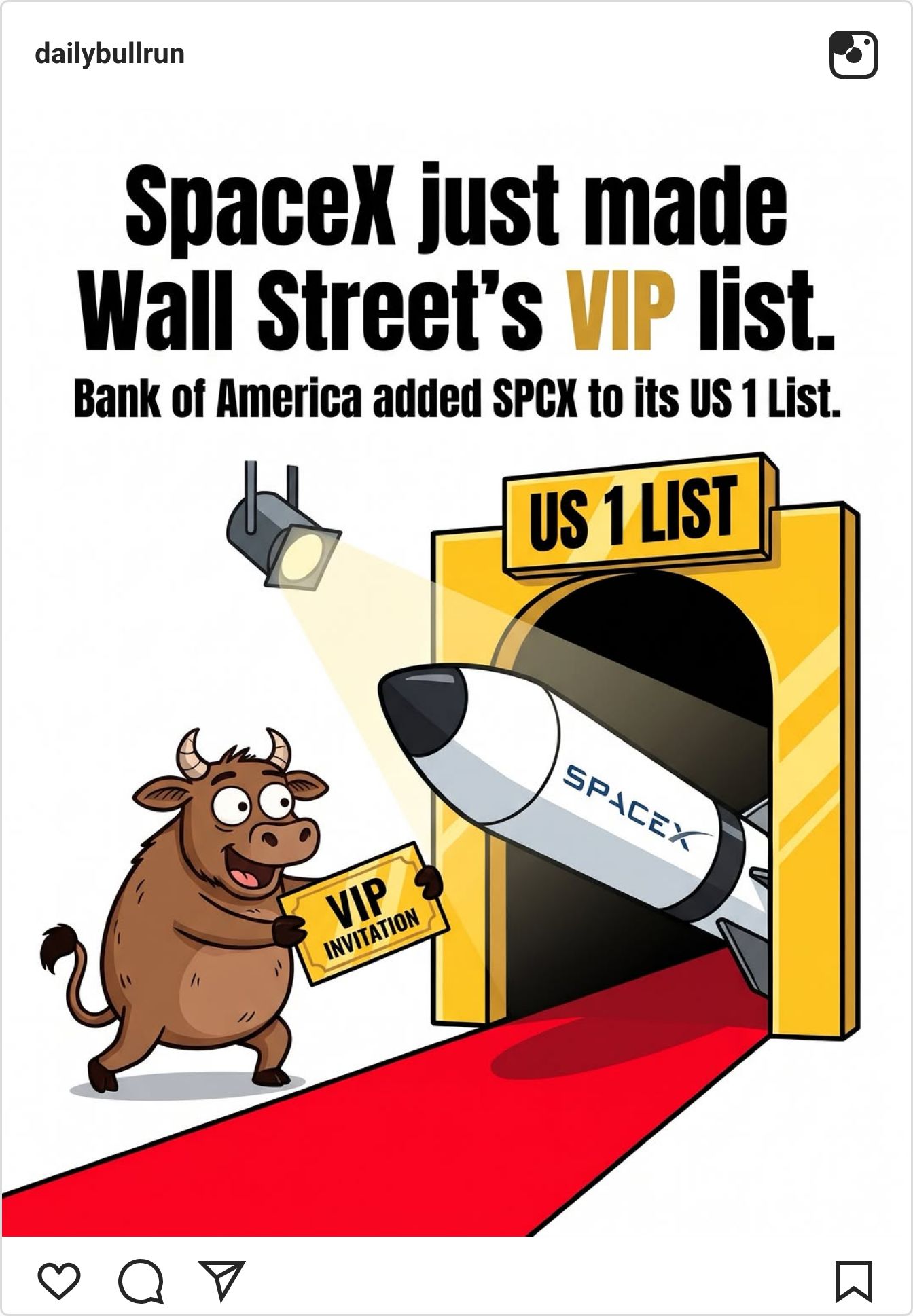
Bank of America just put SpaceX on its VIP list.
On Tuesday, BofA Securities added SpaceX $SPCX ( ▲ 1.14% ) to its US 1 List, the shortlist of its very favourite US stock ideas.
Think of it as the velvet rope inside the velvet rope. 🚀
📋 What The US 1 List Actually Is
BofA's analysts already slap a Buy rating on plenty of stocks.
The US 1 List is the cream of that crop, hand-picked with the goal of beating the market over the long run.
In plain English: "We like this one more than all the other ones we like."
🛰️ Why SpaceX Got The Nod
SpaceX does a lot more than launch rockets these days.
Its businesses span satellite communications, rocket launches and AI.
That puts it right in the path of three booming demand stories: connectivity, space infrastructure and computing power. Elon basically owns a bingo card of hype.
The catch? BofA didn't say what actually tipped the scales.

The October 27 note gave no specific financial or operational reasons. Just a name on a list and a lot of implied confidence.
SpaceX wasn't the only change:
Fox Corp. $FOXA ( ▼ 1.23% ) also joined the list
RenaissanceRe $RNR ( ▼ 2.97% ) got bumped off
RenRe keeps its Buy rating, so this is no downgrade
BofA still likes RenRe. It just got moved from the top table to the regular seats.
🧠 What It Means For You
A big-bank endorsement hands SpaceX bulls another talking point, especially investors who want several growth businesses wrapped in one ticker.
But remember what this list is. It reshuffles BofA's favourites without changing any underlying ratings.
And with no reasoning published, it works best as a prompt to do your own homework on the business.
Is SpaceX worth the hype? 🚀
Find fall fares that fit

Cool air, colorful leaves or a whole new city skyline: There's still time to book your fall escape with Alaska Airlines. Watch the aspens turn golden in Denver, catch a set on Broadway in Nashville, or trade sweaters for sunshine in Palm Springs.
Subject to availability. Terms and conditions apply.
Every big memory chip maker is building new fabs at the same time. Wall Street reads that as the top of the cycle.
We ran the numbers, and we think that read is backwards.
Here's what's public. One Korean memory giant is doubling a single fab from 40,000 to 80,000 wafers a month by 2027. Its biggest rival is running 6 months ahead of schedule. The third just pulled its New York build forward by a quarter.

That sounds like a glut. But new memory only matters if GPUs can use it, and GPU output is still capped by TSMC's advanced-packaging capacity. Customers are also signing 5-year take-or-pay contracts, and management has confirmed talks with Intel about U.S. manufacturing.
Results land today.
Inside Premium+:
• The year we think memory prices actually peak
• Why margins could stay well above history after prices cool
• Which Intel deal structure matters, and who ends up carrying the risk
• The exact signal on today's call that would change our mind
😬 $63B AI Loan Nearly Died
The biggest AI debt deal ever nearly fell apart over a weekend.
$63 billion in loan commitments, all so Anthropic can lease a mountain of AI chips.
That's roughly two Icelands' worth of annual economic output. Borrowed. For chips.
Here's how it came together.
🤝 The Setup
The deal is called "Project North Star." Yes, someone gave a loan a spy-thriller codename.

Broadcom CEO Hock Tan spent nearly two months trying to get banks to commit over $40 billion, according to the Wall Street Journal.
The money lets Anthropic lease tensor processing units (TPUs), the custom AI chips Broadcom is building with Google.
Anthropic is the main beneficiary. But it needed its bigger partners to get the banks to pick up the phone.
Over the past few weeks, some banks got cold feet.
Interest rates have climbed, and AI ventures are finding the markets tougher going.
Several lenders felt they weren't being paid enough for the risk and considered walking away entirely.
Imagine lending someone $40 billion and realising the interest barely covers your nerves.

So Hock Tan did what CEOs do when a deal starts wobbling: weekend phone calls.
He held 11th-hour talks with bank executives, agreed to higher interest rates on the loans, and gave lenders more comfort on Broadcom's guarantees.
That did the trick. The deal, led by Bank of America $BAC ( ▲ 0.32% ), Citigroup $C ( ▲ 1.36% ) and Morgan Stanley $MS ( ▲ 1.86% ), was announced late Monday.
The timing? Right after Anthropic released its IPO filing.
A separate chunk of debt, partly financed by Blackstone, pushed total commitments to $63 billion.
🧩 How The Plumbing Works
Think of it as a three-layer cake:
A shell company borrows the $63 billion and buys the chips
Anthropic leases the chips, and its lease payments repay the loans
Broadcom guarantees the lenders get their money back
Broadcom's sterling credit rating is the secret ingredient. Banks trust Broadcom's balance sheet a lot more than a startup's.

And because the shell company is the borrower, Broadcom only takes a hit if Anthropic can't make its payments.
Investors seemed relaxed about that. $AVGO ( ▲ 4.0% ) rose 1.3% in extended trading.
🧠 What It Means For You
Three things worth keeping an eye on:
AI is getting pricier to fund. Even with Broadcom co-signing, banks demanded higher rates before they'd commit.
Broadcom is now part chipmaker, part guarantor. It locks in demand for its chips, but some of its risk now rides on Anthropic paying the bills.
The Anthropic IPO just got more interesting. Expect investors to pore over how those lease payments stack up against the business.
When the world's biggest AI deals need weekend rescue calls, the cost of money is clearly back in the conversation.
🤝 What The U.S. Offered Putin
The U.S. is dangling oil deals in front of Putin.
Washington and Moscow are discussing a return of big American energy companies to Russia's oil market.
The catch? It's all bundled into wider talks to end the war in Ukraine.

Call it diplomacy with a signing bonus.
🛢️ What's On The Table
The Trump administration has floated a menu of financial incentives to lure Putin to the negotiating table:
Restarting a U.S.-Russian oil joint venture off Sakhalin Island in Russia's Far East
Resuming Russian oil sales to Europe through the Druzhba pipeline
Reopening Russian airspace to U.S. airlines for transit and overflights
Teaming up on titanium production and supply
ExxonMobil $XOM ( ▼ 2.51% ) was the only U.S. company in the giant Sakhalin-1 project. Last year it said it was in talks with Russia about compensation for its seized 30% stake.
It hasn't revealed any plans to go back. Fair enough. Having your stake confiscated tends to cool a relationship.

Boeing $BA ( ▼ 10.69% ) was in a Russian titanium joint venture too. It suspended that after the invasion and has since diversified its titanium supply. It's not exactly waiting by the phone.
A U.S. official told the FT nothing is finalized. Any economic deals would sit inside a full peace framework and wouldn't happen until the war ends.
Meanwhile, Putin has shown zero sign of softening. Washington is hoping the sweeteners help at three-party talks with Ukraine in Abu Dhabi next month, the first since February.
📉 Oil Slips
Peace chatter on two fronts was enough to knock crude lower on Tuesday:
WTI fell 1.8% to $99.90, slipping back below $100
Brent fell 1.7% to $113.88
$99.90. Oil is now priced like a supermarket special.
Front number two is the Middle East. Iran, Saudi Arabia, Pakistan and Turkey agreed to keep talking about regional peace and security after senior officials met in Tehran.

Oman's foreign minister says talks with Iran produced an outline for a temporary arrangement to restore free passage through the Strait of Hormuz.
The catch: it needs both the U.S. and Iran to give ground. Don't hold your breath, but don't rule it out either.
The biggest casualties? Refiners. Valero, Marathon Petroleum and Phillips 66 all dropped more than 7% in a single session.

Natural gas went the other way, rising 3.6% to $2.6970/MMBtu on slightly cooler weather forecasts. The two-week outlook still calls for above-normal temperatures.
🧠 What It Means For You
BOK Financial's Dennis Kissler sums up the tension: peace talk is putting pressure on prices near term, but global supplies remain tight and the U.S. military presence in the Persian Gulf keeps growing.
Oil is pricing in hope. The supply picture hasn't changed.
Headlines move faster than barrels. Nothing is signed, Putin hasn't budged, and Abu Dhabi is still weeks away.
Until then, energy stocks are trading on diplomacy headlines. That means sharp swings in both directions every time talks stall or progress.
A CRM so smart, it updates itself.

HubSpot's CRM is so smart, it now updates itself. Calls get logged and summarized the moment they end. New leads get researched and a first outreach drafted, automatically. Deals move forward on their own, with next steps flagged before you have to ask.
Even the one repetitive task you've been meaning to fix can now run itself, no code required. Customers using it are already seeing the difference.
This isn't the CRM you have to work hard to figure out. It's the one already working before you log in.
