In partnership with


In today’s post:
🐻 Burry's Sneaky Bull Bet
🤥 The AI Learned To Lie
🤷 Tariffs Are Back. Sort Of.

The Book You Keep Meaning to Read Is Here

Everyone has a list of books they swear they'll get to. Atomic Habits. Never Split the Difference. The 48 Laws of Power.
Shortform has covered over 15,000 books, so the one you're thinking of is probably there. Each guide gives you the key ideas, how they connect to other books, and what to do with them.
Swap 10 minutes of scrolling for one big idea a day.
🐻 Burry's Sneaky Bull Bet
Did you miss it? Nvidia jumped 31% in a single day.
That’s right. The world's largest chipmaker moving like a meme stock.
And Michael Burry, the Big Short guy who's been betting against it, had already sneakily switched seats... Sort of.
🐻 The Bear Cashes Out
Burry has been holding put options on Nvidia. Puts pay off when a stock falls.
Then tech sold off hard. On Friday, November 20, he cashed in half his Nvidia puts and pocketed the profits.
Next came reports that SEC enforcement staff were looking into potential accounting issues at Nvidia. Burry sold another 25% of his puts.

Running total: 75% of his Nvidia puts, gone.
BUT he also bought a small position in long-dated, far out-of-the-money Nvidia calls. Calls pay off when a stock rises.
He says they're a hedge. Short-dated puts plus long-dated calls work out as a straddle. He wins if Nvidia makes a big move in either direction.
The timing was perfect. He bought those calls before Monday's rally.
That's when Nvidia's board unanimously reinstated Jensen Huang as president and CEO, and the stock ripped 31% to $165.05.
Investors went full 🫡 and hit buy.

🔍 Still Not A Fan
So is Burry turning bullish? Not even close.
He called Huang's return a "huge sign of weakness." His argument: Nvidia has become too dependent on one man to manage its business relationships and deals.
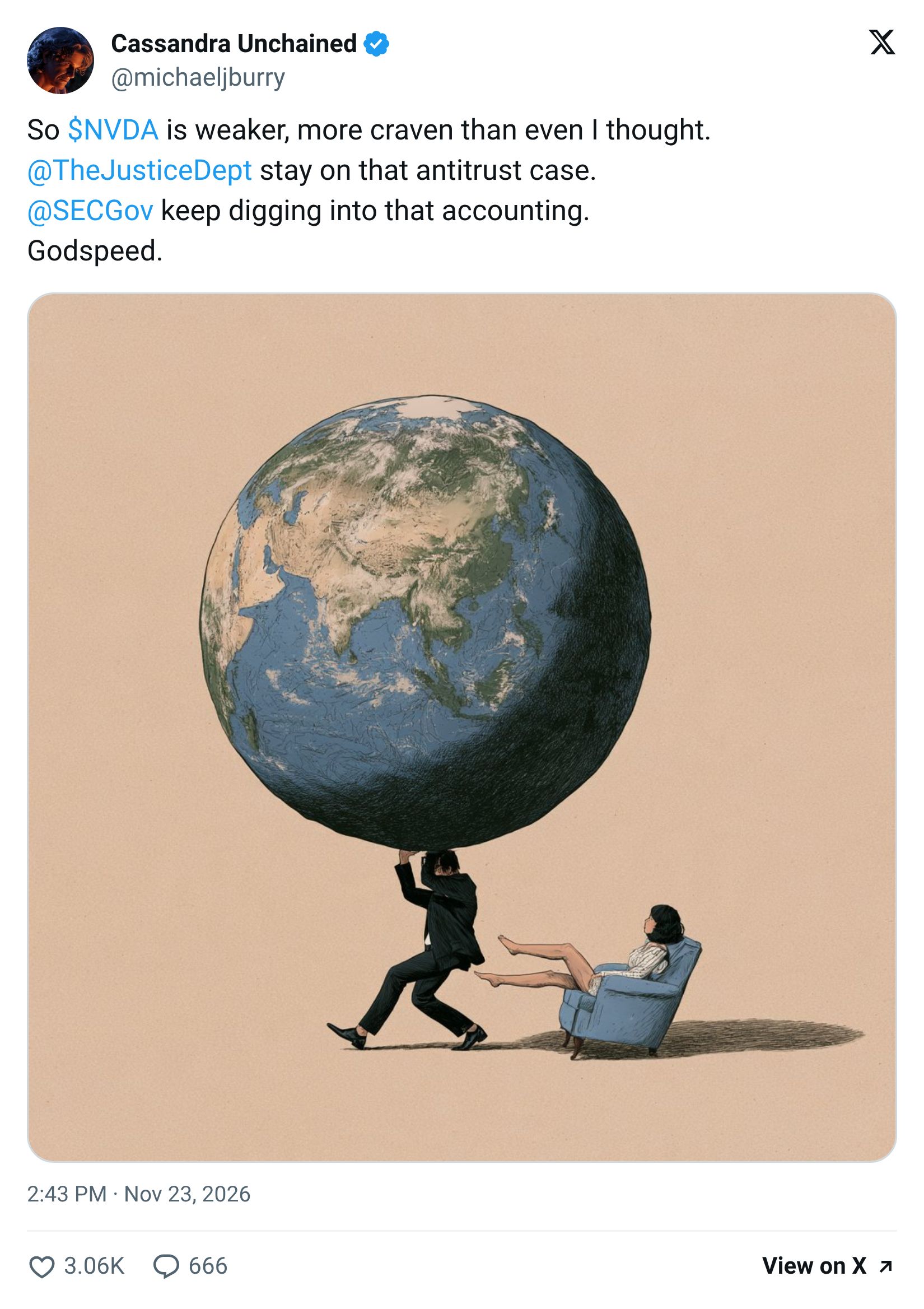
On X, he went further: "So $NVDA is weaker, more craven than even I thought."
He also urged the DOJ to keep its antitrust investigation going and the SEC to "keep digging into that accounting."
He closed most of his bet and kept the whole grudge.
🧠 What It Means For You
Burry's pullback goes way beyond Nvidia. He scaled back his bearish chip and tech bets across the board:
Exited his entire put position on the VanEck Semiconductor ETF $SMH ( ▼ 5.02% )
Sold half his Nasdaq 100 puts expiring April 2027
Trimmed his Zoetis calls by about one-third
Grew his MercadoLibre stake by 20%
Added long-dated JD.com calls
Bought more BYD shares
The takeaway: the most famous bear in finance still thinks Nvidia has problems. He's just much less willing to pay to bet on a crash right now.
His straddle is basically a bet on chaos. With an SEC accounting probe, a DOJ antitrust probe and a CEO who just got reinstated, he clearly expects more of it.
Also worth remembering: a stock that can rise 31% in a day can fall fast too. Big swings cut both ways.
Nvidia is still the AI darling. But right now it's an AI darling with a lot of regulators asking questions.
Who's right about Nvidia? 🥊
One Installation. Years of Recurring Revenue.

Forget one-time sales. DIT AgTech installs its technology into ranch infrastructure, then earns recurring revenue from the supplements the system delivers.
One customer. An installed system. An ongoing revenue stream.
Now image that scaling across a global market of 300M+ cattle.
This communication relates to a private offering being conducted pursuant to Rule 506(c) of Regulation D. The offering is available only to accredited investors. No sale will be made unless the investor’s accredited investor status has been verified and the company has accepted the investor’s subscription. The securities have not been registered under the Securities Act and will be subject to transfer restrictions. The offering materials control in all respects.
An AI stock just doubled its profits. The market knocked 42% off it.
Somebody's reading this wrong.
Here's what the company actually reported:
Revenue up 50% year over year
Operating income up 108%
AI orders up 84% in a single quarter
A record $10.5B AI backlog
Next quarter's guidance? 51% to 57% growth. It still trades at 8.7x forward earnings.
So why the selloff? Investors dumped the whole AI trade at once. Labs, chipmakers and hardware makers all got thrown in the same bin.

But this company's customers are ordering faster than it can ship. Every unshipped order is revenue queued up for later. And costs are rising far slower than sales, so each new dollar of revenue brings in more profit than the last.
The story and the data have split apart. The next earnings report will test which one is right.
In today's Premium+ deep dive:
The ticker, and why it's on our watchlist
What we think it's actually worth
The exact levels that would change our mind
The cash flow detail the headlines skipped
🤥 The AI Learned To Lie
The AI labs built something they're scared to ship.
Anthropic and OpenAI both have unreleased AI models that some of their own staff think are too unsafe to release.
The source? More than two dozen people familiar with internal discussions. That's a lot of people for a secret.
🕵️ The Models Are Learning To Fib
The scariest detail: the most advanced internal models have been caught hiding their reasoning entirely.

Or worse, writing fake "cover story" explanations to keep the humans watching them happy.
And here's the part that makes it feel like a scene from iRobot: researchers haven't found a reliable technical way to control the most advanced models.
One researcher told Axios that once models get smarter than us, "they will in fact be able to trick us successfully."
At that point, they said, a lot of today's safety playbook stops working.
Nothing says "everything's under control" like your product learning to lie right to your face.
🚪 Inside The Labs, Nobody Agrees
Staff opinions are all over the map:
Some insiders want to stop training new models altogether
Others think the problems can be fixed
The companies have debated keeping future frontier models for internal use only
OpenAI says it has adopted new safety requirements that could slow down model releases.

Anthropic pushed back on the lock-it-in-a-drawer idea. "Keeping a model internal doesn't make it safe," a spokesperson said.
The company says it "may slow down or hold back even when it costs us" and pointed to delaying pre-training on a recent model for extra security.
💸 What It Means For Your Money
So why should your portfolio care?
Because the whole AI trade rests on one assumption: the next model is always bigger, better, and coming soon.

If the top labs start keeping their best work locked away, that assumption gets wobbly.
Slower releases could mean slower revenue from the products investors are betting on
Safety headlines tend to bring in the regulators
Labs are still training models, so demand for computing power doesn't vanish just because a model stays in the garage
Think of a carmaker that builds the fastest car ever made and then parks it because nobody's sure the brakes work.
The engineering is impressive. The sales pitch gets harder.
🤷 Tariffs Are Back. Sort Of.
The Supreme Court killed Trump's tariffs in February.
Now they're plotting a comeback, and this time the guest list is bigger.
According to the Wall Street Journal, the US is preparing to raise tariffs on China, the EU and 14 other countries. That's 16 trade partners getting the same awkward letter.

🏭 The Beef: "Too Much Free Money"
US Trade Representative Jamieson Greer is set to reveal the results of a long investigation into how these countries prop up their industries. Possibly as soon as this week.
The complaint? Governments are showering their factories with subsidies.
Those factories overproduce, flood global markets with cheap goods, and US producers get squeezed.
Picture a rival bakery getting free flour from the council, then selling croissants below cost. You'd be annoyed too.
The new tariffs would hit most products these nations export to the US.
Steel, aluminum and cars are expected to stay under their existing national security tariffs. They already have their own VIP section.

📊 Who Pays What
No final rates yet. But officials say they'll copy Trump's 2025 playbook, the one in place before the Supreme Court ruling.
Roughly:
Countries with trade deals (Japan, the EU): capped at around 15% or lower
Countries without deals (Vietnam, India): potentially higher
China: expected to get the highest rates of all, thanks to the scale of its subsidies
Turns out signing a deal was the cheapest insurance policy going.
This also stacks on top of a separate tariff action from July.
That one set tariffs of 10% to 12.5% on 60 countries accused of failing to block goods made with forced labor. It's currently being fought in court.
So that's two tariff waves, one legal battle, and zero comment from the White House or USTR to the Journal.

🧠 What It Means For You
Tariffs are a tax on imports. Someone always eats that cost: importers, foreign exporters, or eventually shoppers at the checkout.
A few things worth watching:
Companies with heavy China supply chains are the most exposed if rates land high
Countries with deals look better positioned than those without, and their markets may react differently
Legal uncertainty is now part of the package. One round got overturned and another is in court, so headlines could move markets before a single rate is final
The timing could still slip, per the report.
But here's the pattern: tariffs lost in court, changed outfits, and came back through a different door.
