In partnership with


In today’s post:
🫧 Is AI The Next Dot-Com Bust?
🚀 $1B/Month. Google Wants More
🕵️ Nvidia Chips Found In China

One installation. Recurring supplement revenue. DIT AgTech embeds AI-powered nutrition technology into ranch infrastructure, building a sticky business model. 400,000 cattle on the platform.
🫧 Is AI The Next Dot-Com Bust?
Meta's free cash flow went negative.
That's the first time in 14 years. Back then, Meta was still called Facebook and was fresh off its IPO.

And they’re not the only ones. When the most profitable companies on Earth start spending more cash than they bring in, people notice.
The recent tech selloff has dragged the question everyone's been dodging back into the room:
Is the AI bubble about to pop? 🫧
Let’s blow the dust off the case file.
💸 The Money Trail
Global AI venture funding has more than halved since Q1, according to CB Insights:
Q1: $226B
Q2: $153.1B
Q3: $103.3B
Some fine print: a few monster cheques pumped up the early quarters.
OpenAI's $122B raise was over half of Q1 by itself. Anthropic's three mega-rounds added $65B to Q2.
Corporate spending hasn't budged, though. Goldman Sachs expects ~$1 trillion of global AI investment this year, with just under $600B of it in the US.
That works out to roughly $31,700 every second, all year long.

Nobody told the CFOs to slow down.
🪓 Dot-Com Déjà Vu
In a gold rush, the people selling shovels get rich. Nvidia is the AI era's shovel shop.
In early 2000, that job belonged to Cisco $CSCO ( ▲ 3.02% ) and Lucent, which were among the most valuable companies on the planet at the time.
Then the crash came. Lucent lost nearly all its value, and Cisco fell ~80-90%.
The more worrying parallel is circular financing.
Chipmakers and cloud firms invest in or lend to AI labs and neocloud operators. Those same customers then commit to buying chips and compute from the companies that funded them.

Imagine a car dealer lending you the money to buy his car, then calling the sale "strong demand." 🚗
FTSE Russell called it "a sophisticated vendor-financing structure, but at an extraordinary scale."
Their closest comparison is the late-1990s telecom buildout. Back then, optimistic demand forecasts led companies to build far more infrastructure than anyone needed.
Cisco, Lucent and Nortel lent cash-strapped customers money to buy their hardware. Sound familiar?
🧠 What It Means For You
The scale is huge. Brookings estimates AI buildout spending will reach $10.3 trillion from 2025 to 2032, averaging 3.63% of US GDP every year.
That's bigger than the US railroad, highway and telecom booms. The biggest building projects in American history just got lapped.
The main difference from 2000 is that today's biggest spenders are some of the most profitable companies ever. Pets.com never had a war chest like theirs.
That cushion is getting thinner, though. Meta's cash flow going negative is the first real crack.
If you hold a broad US index fund, you're probably more exposed to this trade than you realise, because these giants make up a big chunk of it.
Cash flow is the number to watch. While the spenders can pay for the buildout out of profits, the boom has a safety net.
If more of them follow Meta below zero, all that circular money starts looking a lot more like 1999.
Shovel sellers only do well while the miners keep digging. ⛏️
Is the AI bubble about to pop? 🫧
Turn your expertise into working software

Describe what you want to build
Get real software, not a prototype
Lovable handles payments, logins, databases
Change any detail yourself, any time
Put it in front of customers this week
Discount of $5 applies to first month of any paid plan. You need to sign up via this webpage in order to claim the discount. The discount applies to new and returning users without an active paid plan. Terms apply.
🚀 $1B/Month. Google Wants More
Google is paying SpaceX roughly $1 billion a month. And it wants more.
That's about $33 million a day. Or $1.4 million every hour, including 3am on a Sunday.
🚀 The Saturday Tweet
An X user reckoned Google would end up buying more AI compute from SpaceX $SPCX ( ▲ 4.83% ) than Anthropic $ANT ( ▲ 10.98% ) would.
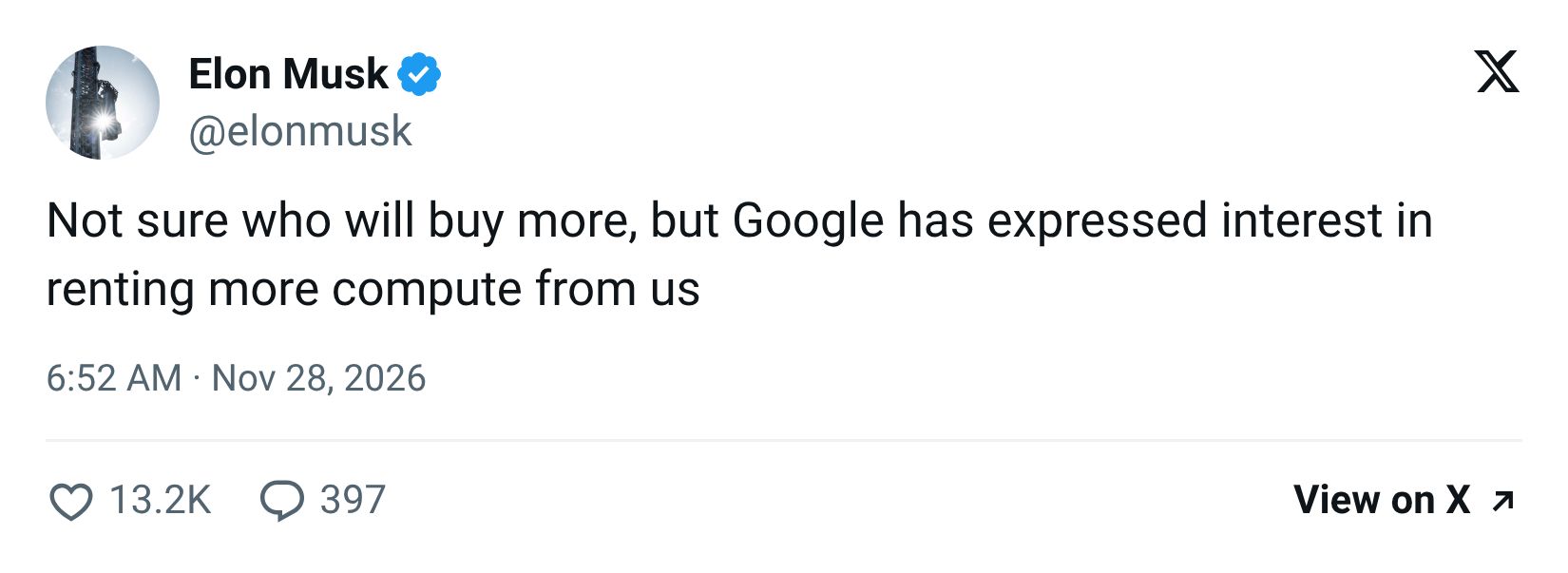
Elon Musk replied: "Not sure who will buy more, but Google has expressed interest in renting more compute from us."
For now, this is a weekend tweet with no formal confirmation. File it accordingly.
💸 The Deal Google Already Signed
Google $GOOGL ( ▲ 0.68% ) is already a big SpaceX customer:
In June, the two signed a multi-year AI deal
Google gets access to at least 110,000 Nvidia $NVDA ( ▲ 0.8% ) chips
The price: roughly $1B per month, in a deal reportedly worth up to $30B

That deal landed just before SpaceX's IPO earlier this year. Nothing helps an IPO pitch like a trillion-dollar tenant.
Google wasn't the first tenant either. In May, SpaceX agreed to lease its Colossus data center clusters to Anthropic, the Claude maker, on a six-month deal.
So a rocket company is now a landlord to two of the biggest names in AI. Your landlord can't even fix the boiler.
🧠 What It Means For You
Why would Google, which owns some of the biggest data centers on Earth, rent chips from a rocket company?
The likely answer: even the giants can't get compute fast enough on their own. When Google is shopping around for capacity, the AI arms race is clearly still accelerating.
What that could mean:
SpaceX: renting out compute is turning into a serious revenue stream alongside the rocket business
Google: its appetite for AI spending shows no sign of cooling
Nvidia: every rented cluster is more demand for its chips, wherever they sit
One big caveat: "expressed interest" isn't a contract. Musk's posts on X have a wide range of outcomes, from "happened exactly as described" to "never mentioned again."
Until something gets signed, it's a signal and nothing more.
🕵️ Nvidia Chips Found In China
One of Nvidia's most powerful server racks just turned up in Shanghai.
As collateral. For a bank loan.

🕵️ The Serial Number That Snitched
Bloomberg went through November filings to Chinese regulators for a data center called the Yangtze River Delta Project.
They found a GB300 NVL72 rack, one of Nvidia's top Blackwell products, sitting at the site.
Shanghai Shuoyao put the rack up as collateral for a 96M yuan ($14M) loan from Shanghai Innovation Bank. Bloomberg matched its serial number to a Gigabyte-built rack in a public warranty database.
Turns out serial numbers are terrible at keeping secrets.
Why does it matter? Shuoyao overlaps heavily with Megaspeed, the Singapore firm under US investigation for allegedly smuggling Nvidia chips into China. Shuoyao confirmed this month that it was a Megaspeed service provider.
It gets better. A second firm, Shanghai Kezhan, listed a Blackwell-powered GB200 server at the same site to get a 90M yuan loan in late 2025.
The lender was a finance-leasing firm owned by a Shanghai government agency. Awkward.
🎢 Three Weeks Of Corporate Soap Opera
The data center is linked to Alice Huang, the woman at the centre of Nvidia's scandal. Quick recap:
Nov 11: Jensen Huang resigned over reports of extramarital relationships, including one with a former Megaspeed exec that US authorities suspect has links to Chinese intelligence
CFO Colette Kress stepped in as interim CEO
Current and former staff plus tech heavyweights petitioned for his return, and Trump says the board got national security assurances "at least with everything we know"
Nov 23: Huang was reinstated as CEO, President and board member

The market reaction? Shares ripped 31.6%, adding over $1 trillion in a single day.
That's more than double the biggest one-day gain in stock market history. The Nasdaq went up 6.5% with it.
One man's job title moved the whole tech sector. No pressure.
🏛️ Jensen Goes To Washington
The hearings are next week:
Dec 1: Closed-door hearing with the House Foreign Affairs, Intelligence and China Select committees
Dec 2: General counsel Tim Teter faces the same committees
Dec 3: Public hearing with the Senate Banking Committee

Huang has hired Joshua A. Levy, a lawyer who specialises in congressional investigations. Sensible when you're about to get grilled in public.
The real risk is tighter export controls, closed loopholes and more scrutiny on Big Tech. That gets messy fast, because most of the raw materials for GPU chips come from China.
There are two more probes as well. California AG Rob Bonta is investigating whether Nvidia chips reached China illegally, and the SEC is looking at potential accounting issues. There are almost no details on the SEC one so far.
💰 What It Means For Your Money
Here's the bull case. China and the "Asia loophole" are 15% to 20% of revenue at most, and Nvidia's 4Q27 guidance already assumes none of it.
The demand side is enormous:
~$1.5 trillion in Big Tech capex expected next year
$2.5 trillion cloud industry backlog
160 GW of demand through 2029, against only ~80 to 100 GW of planned capacity
Vera Rubin shipped nearly $20B in its first production quarter, with Rubin Ultra due next year and Feynman in 2028
Management is holding gross margins at 72% to 73% for FY28
So the business looks solid. The headlines are the wild card.
This week Jensen walks into DC carrying the entire AI trade on his back. Buckle up.
14% Annualized, With Dividends Paid Each Business Day

Nasdaq-listed variable-rate perpetual preferred stock
14% annualized dividend rate, currently
Dividends paid each business day when declared
DFDV estimates 100+ years of coverage
CHAD is variable-rate preferred stock. Dividends are not guaranteed, and the dividend rate may change. Investment involves risk, including possible loss of principal. CHAD is not FDIC insured. For important risks, disclosures, and prospectus, visit whoischad.com/disclaimer.
