In partnership with


In today’s post:
🚨 Jensen’s Gone. Here’s Why
💍 Elon Is Marrying Himself
🚀 27% Odds Jensen Joins Elon

The ice cream shop that makes money when it's cold

28 Wishes sells ice cream in Los Angeles. Below 70°F, sales fall about 20%. The weather is out of their hands. Rent isn't.
So the owners started putting about $20 a day into Kalshi weather markets, taking the cold side. The days that keep customers away now pay something back.
This is hedging. Big companies have done it for decades, buying protection against bad weather, fuel spikes and rising rates. It used to take a broker, a trading desk, and an order size no corner shop could meet.
Kalshi opens it up. Contracts on weather, fuel prices, inflation, tariffs and regulation, starting at a few dollars. Take a position on the outcome that would hurt you. If it hits, the payout softens it. If it doesn't, the contract expires and the good month was the point.
🚨 Jensen’s Gone. Here’s Why
Jensen Huang is out at Nvidia.
The leather jacket has left the building. Effective immediately.
The man who built Nvidia over 33 years resigned Thursday as CEO, president and board member. All three titles, gone in one press release.
Shares dropped more than 6% on the news, though they did climb back off the day's lows.
🕵️ The Plot Nobody Saw Coming
This reads like a spy thriller written after one espresso too many.

Days earlier, Nvidia's board opened an investigation into whether Huang was the target of a foreign intelligence operation.
Huang disclosed he'd been unfaithful to his wife with Alice Huang (no relation), a Singapore-based data center executive who is alleged to have spied on him.
On Wednesday, reports surfaced of a possible second extramarital relationship with Kimberly Powell, an executive who reports directly to him.
The Wall Street Journal then reported the board was preparing to remove him.
By Thursday, he was gone.
Wall Street saw it coming. Several firms downgraded the stock earlier Thursday, before the resignation was even public.
👔 Who's In Charge Now?
CFO Colette Kress steps in as interim CEO. She keeps the CFO job too.
So one person is now running the money and the whole company. That's two of the hardest jobs in tech at once.
The board also named Harvey Jones as Nvidia's first-ever Chairman. He's the former CEO and Executive Chairman of Synopsys.

The board says operations, customer commitments and the product roadmap will continue "without interruption."
Please stay calm and keep buying GPUs, is the message.
A search for a permanent CEO is underway, with internal and external candidates in the mix.
🧠 What It Means For Your Money
Dan Ives at Yorkville Ives, one of Nvidia's loudest bulls, thinks Nvidia could be worth 25% less without Huang.
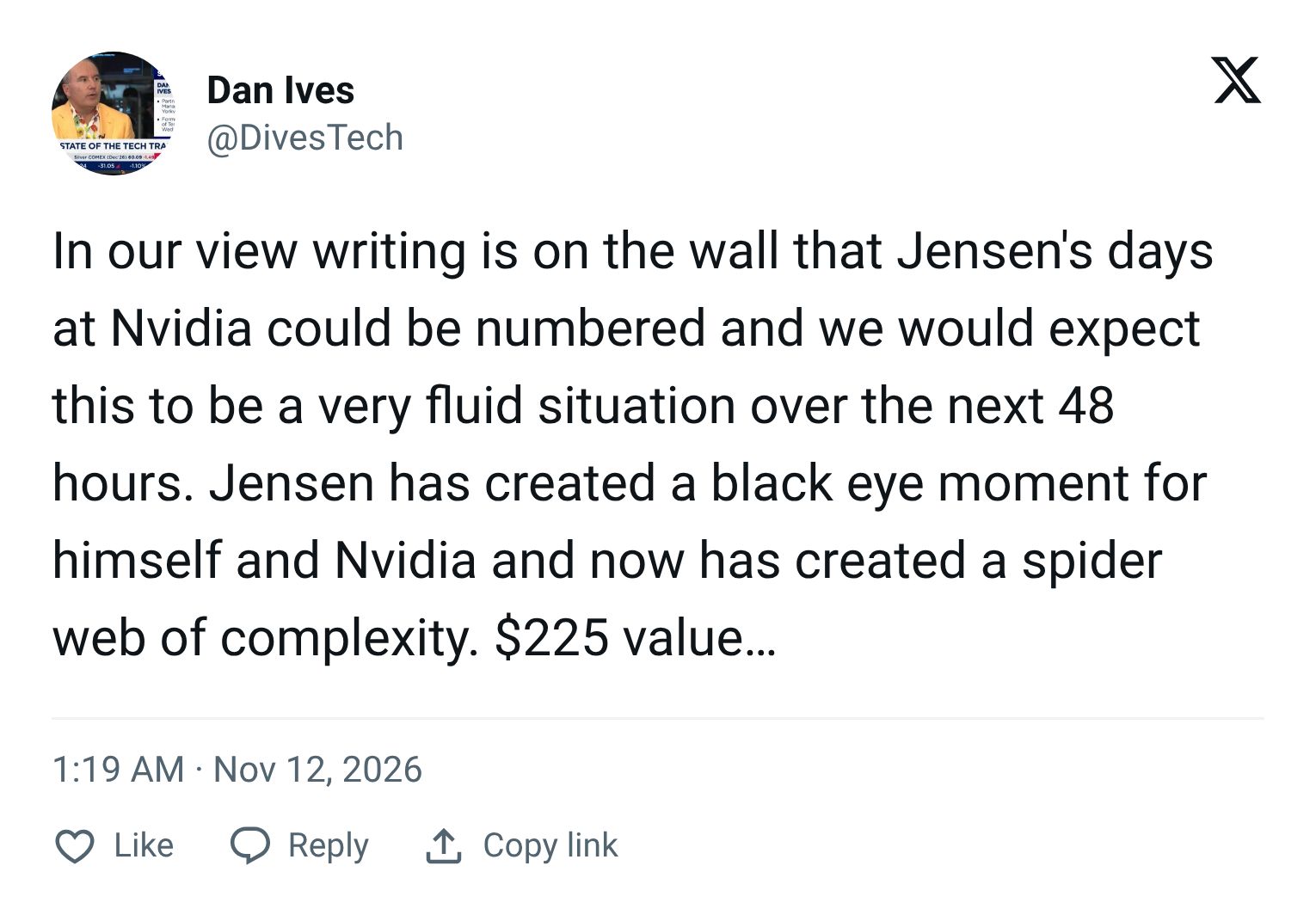
That's a quarter of the company's value, tied to one guy in a leather jacket.
He also called it a "black eye moment" and expects congressional inquiries and a lingering overhang on the stock.
Why does one person matter this much? Because Huang has been the face of the entire AI boom. When investors bought the AI story, a lot of them were buying Jensen.
And if you own an S&P 500 or Nasdaq tracker, you own a slice of Nvidia whether you meant to or not.
Two dates to circle:
Nov 17: Q3 fiscal 2027 results, with the earnings call at 5pm EST, as already scheduled.
Nov 18: All-hands employee meeting, with Kress speaking.

Earnings next Tuesday are Kress's first real test. Strong numbers would remind the market that AI chip demand never depended on one person. If they wobble, the leadership chaos will get the blame.
Either way, it's about to be a very loud week.
Who should run Nvidia now? 👔
The 5 Stocks Nvidia Can't Grow Without

Every Nvidia chip needs servers, networking, power and a data center to run. Analysts say the smaller companies supplying those pieces have more room to grow, with price targets up to 55%. Get all five tickers texted to you free today.
The world’s most valuable chip company just lost its CEO, and Wall Street grabbed the scissors.
So is this a discount or a warning?
Price targets are getting slashed. Meanwhile, the demand data hasn’t flinched.
The company has guided to growth approaching 100%.
Its CFO said sales would far exceed estimates if supply weren’t the bottleneck.
That’s the part most coverage skips.

When demand outruns supply, a customer who pulls back doesn’t leave a hole. The next buyer in the queue takes the chips. Very few rivals have the manufacturing capacity to serve that queue at all.
The question is whether a CEO exit can break that loop, or just make the headlines louder.
Earnings land November 17. Q4 guidance is the first real test.
In today’s Premium+ deep dive, we break down what we’re watching and why:
🔍 The one line in the Nov 17 report that shows whether the scandal reached the order book
🧠 What Big Tech’s CEO-swap history really tells us, and where it misleads
🚪 The exact level that would change our mind
⚠️ The risk consensus is barely pricing in
Analysis to help you decide for yourself.
💍 Elon Is Marrying Himself
Elon Musk might be about to merge with... himself.
And it could be the biggest corporate acquisition in history.
According to Bloomberg, merger talks between SpaceX $SPCX ( ▲ 0.14% ) and Tesla $TSLA ( ▲ 1.69% ) are picking up speed, and a deal could be announced as soon as next month.
And the numbers are silly…
SpaceX: valued at over $1.9 trillion after its June IPO
Tesla: worth roughly $1.5 trillion
Together: a $3.4 trillion industrial and AI giant
That's roughly the size of the entire UK economy. All of it with one CEO, who also posts memes at 3am.
Special board committees and advisers are negotiating the structure, governance and share-swap terms right now.

Musk wants it done fast. An announcement could come in December, possibly timed for Tesla's annual shareholder meeting on Dec. 3.
But deals this big rarely run on Elon time. It could slip into early 2027.
Then again, what does run on Elon time? Ask anyone still waiting on a Roadster.
🤖 So Why Merge At All?
The pitch: one company that builds everything with a battery, a chip or a rocket attached. That means:
Self-driving cars
Humanoid robots
Energy storage
Satellites
AI infrastructure in space

These two are already dating. They jointly run Terafab, a chip plant in Texas. A merger would just make it official.
🇨🇳 The China Problem
Here's the catch. Tesla has huge manufacturing operations in China. SpaceX holds sensitive US defense and national security contracts.
Putting those under one roof makes regulators break out in hives.
Before anyone approves it, the dealmakers have to wall off Tesla's China business from SpaceX's defense work.

JPMorgan analyst Rajat Gupta says these conflicting pulls will complicate both regulatory approvals and shareholder votes.
Then there's Washington. Democrats just won control of Congress in the midterms and have promised to scrutinise Musk's business dealings.
Musk picked a fun moment to ask for permission.
🧠 What It Means For You
If you hold TSLA, the share-exchange ratio is the number that matters. It decides who gets the better end of the deal: Tesla holders or SpaceX holders.
Depending on the structure, Tesla shareholders could end up owning a slice of rockets, satellites and defense contracts. Some will love that. Others signed up for cars.
Expect plenty of headline-driven price swings while regulators, shareholders and Congress all weigh in.
The deal isn't done. Right now this is talks plus a tight deadline, and those have a habit of moving.
🚀 27% Odds Jensen Joins Elon
Traders give Jensen Huang a 27% shot at joining Elon.
That's on Kalshi, where the odds of Huang landing at SpaceX/xAI jumped 20 percentage points.
The man only just quit. Bettors already have him picking a desk at a rocket company.
Here's the full list of Kalshi traders think the leather jacket goes next:
SpaceX/xAI: 27%
AMD: 9%
Tesla: 9%
Intel: 7%
Apple: 3%
Elon's companies hold two of the top three spots.
27% is slightly better than calling two coin flips in a row. That's a long shot, but it's the favourite.
Apple at 3% is about the odds of calling five coin flips in a row. The market is politely saying "nah."
Now the catch. Volumes are thin, and Polymarket puts the same Musk bet at only around 10%.
Same question, two markets, a 17-point gap. Wisdom of the crowd works better when there's an actual crowd.
🐦 How Elon Slid Into The Chat
Late Wednesday, financial blog ZeroHedge posted on X urging Musk to hire Huang.
Musk replied: "That would be an honor."

Four words, and he posted them before Huang had even resigned. Most people wait for the job to open before making an offer.
Still, you can see the logic. Musk keeps growing his AI infrastructure ambitions, and Huang spent 33 years building the hardware that runs them.
What could be scarier for rival chipmakers than Elon with a bigger budget? Elon with Jensen on speed dial.
🧠 What It Means For Your Money
Zoom out and the bigger number is this: Polymarket gives only 20% odds that Huang joins a new company by December 31, 2026.
Flip it around and traders see an 80% chance he hasn't signed anywhere new by New Year's.
When he does move, where he lands matters:
A rival chipmaker (AMD, Intel): the person who knows Nvidia's playbook best would be helping the competition write theirs. Nvidia holders would feel that one.
Elon-world: Musk's AI push gets the most famous name in chips. That's a headline for AI, though not a head-to-head fight with Nvidia.
His own venture or an advisory role: prediction markets are tracking both of those too.
For now, these markets are sentiment, not a crystal ball. They tell you what people are excited to bet on, which isn't always what happens.
Watch the odds anyway. If one destination suddenly spikes on real volume, that's usually the moment the rumour mill turns into actual news.
